
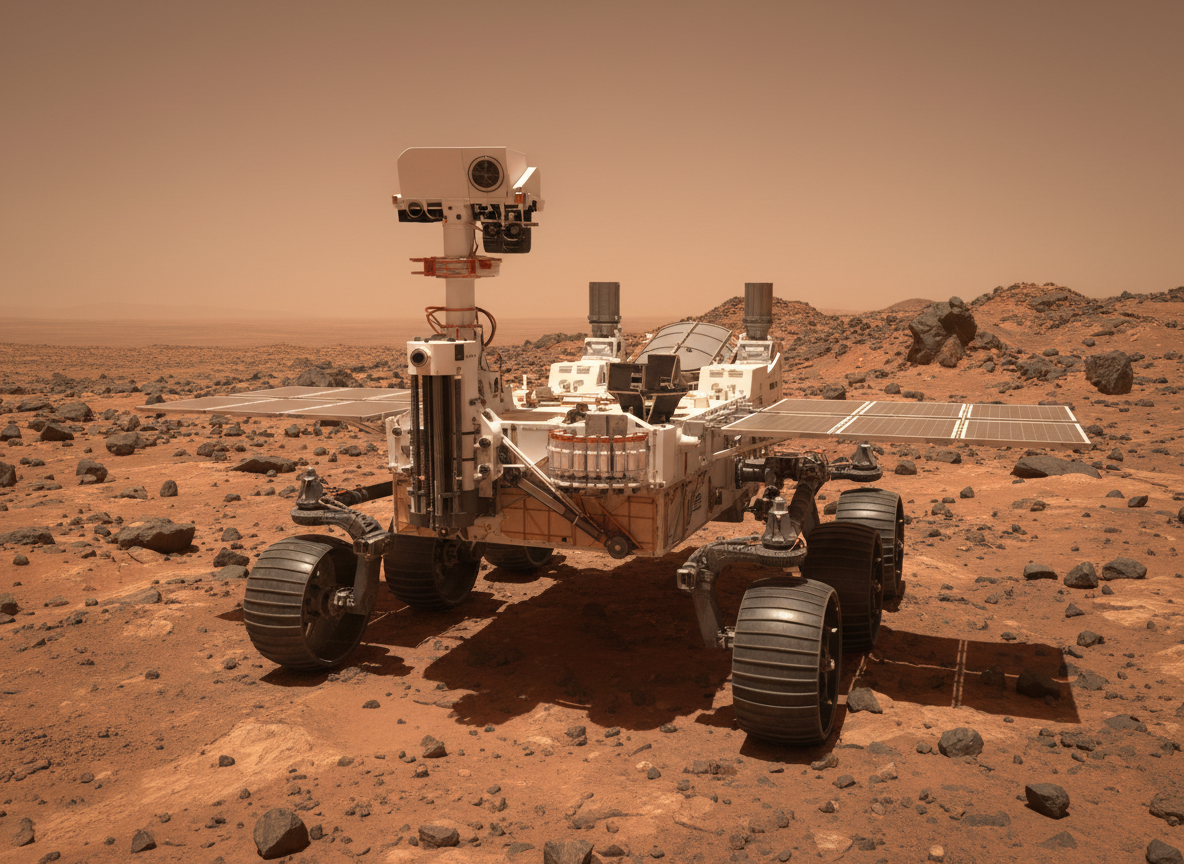
TerraNaut VII
Subsurface Drilling & Analysis Rover — Mars Subsurface Research Division
Program Overview
TerraNaut VII will be OrbitExSpace's primary Mars deep-drilling platform, designed to extend surface science capabilities far beyond current rover programs. While drawing on the engineering heritage of NASA's Perseverance rover chassis design, TerraNaut VII will introduce a fundamentally new drilling depth capability and AI-driven geochemical analysis architecture.
The vehicle will operate across the Jezero and Isidis basin regions, targeting geological transitions where subsurface habitability conditions are most likely to have existed. All operations will be conducted autonomously with a 72-hour command uplink cycle.
Department
Mars Subsurface Research Division
Target Regions
Jezero Crater, Isidis Basin
Mission Duration
Primary: 1 Mars year (687 sols)
Chassis Heritage
Perseverance mobility reference (10%)
Technical Specifications
Chassis
6-wheeled rocker-bogie, titanium/aluminium
Mass
~1,120 kg
Power Source
Solar array + Li-ion thermal buffer
Drill Depth
10+ meters, rotary-percussion system
Sample Capacity
40 sealed core tubes per traverse
Comms
X-band direct-to-Earth + OEX Mars relay
AI Architecture
Neural Autonomy v4, geological inference
Drive Speed
180 m/hr average terrain traverse
Operational Duties
Subsurface Core Drilling
TerraNaut VII will drill to depths exceeding 10 meters at designated geological priority sites, extracting continuous core samples for analysis. The drill system will build on Perseverance-heritage percussive coring architecture, scaled for deep bore capacity.
Biosignature Geochemistry
Onboard mass spectrometry and Raman spectroscopy instruments will analyse core samples in real time. The AI subsystem will flag anomalous geochemical readings for priority uplink and follow-up investigation without waiting for ground confirmation.
Subsurface Thermal Profiling
TerraNaut VII will deploy resistive thermal probe arrays at each drill site, building a subsurface thermal map of target zones. This data will inform the placement of future pressurised habitat foundations requiring stable thermal environments.
Sample Caching & Retrieval Staging
Cored samples will be hermetically sealed in standardised tubes and staged at pre-designated cache sites for recovery by future Mars sample return missions. TerraNaut VII will log GPS coordinates and environmental conditions for each cache.
Autonomous Traverse Planning
Using terrain models built from orbital data and onboard stereo cameras, the vehicle will plan multi-week traverse routes autonomously, prioritising scientifically significant geological targets while managing power and communication windows.