
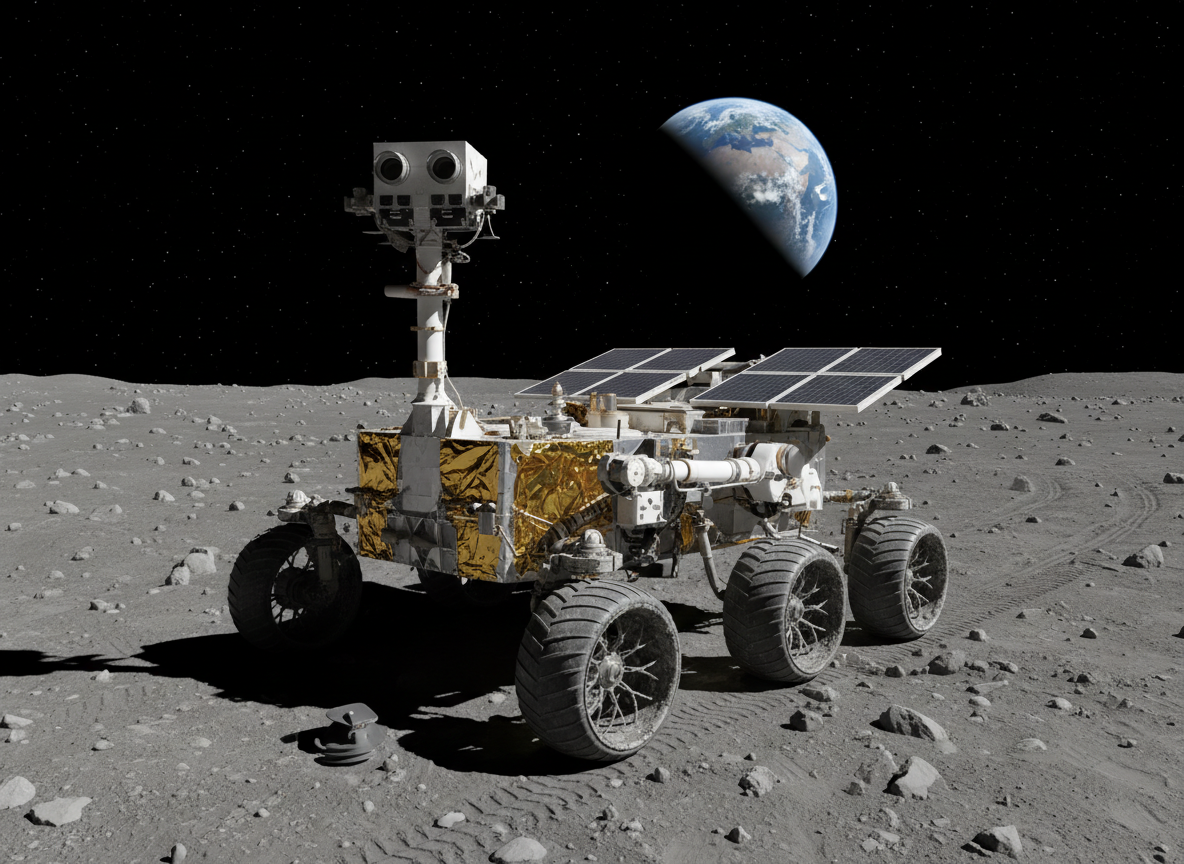
OEX Lune-Traverse I
Geological Survey Crawler — Lunar Surface Operations Division
Program Overview
The OEX Lune-Traverse I will be OrbitExSpace's primary long-range geological survey platform for sustained lunar south pole operations. Drawing on rocker-bogie mobility heritage from the Perseverance and Curiosity rover programs, the vehicle will be purpose-engineered for the extreme cold and permanent shadow terrain of the lunar polar region.
The platform will be autonomous from day one of surface operations, requiring no real-time operator commands for routine traverse and sampling. All navigational decisions will be executed onboard by the Neural Autonomy v4 stack, with daily mission summaries uplinked to OEX Lunar Mission Control.
Department
Lunar Surface Operations Division
Program Lead
Surface Systems Engineering
Mission Duration
Primary: 3 lunar years
Instrument Heritage
10% NASA VIPER-derived sensors
Technical Specifications
Chassis
6-wheeled rocker-bogie, aluminium alloy
Mass
~920 kg (unfueled)
Power Source
Dual solar array + Li-ion buffer cells
Operating Range
12 km/sol autonomous traverse
Drill Depth
Up to 2.5 m subsurface
Comms
UHF relay via OEX lunar orbital node
AI Architecture
Neural Autonomy v4, 7-tier decision stack
Terrain Rating
30° slope, 45 cm obstacle clearance
Operational Duties
Geological Survey
The OEX Lune-Traverse I will conduct systematic multi-spectral surface surveys across a 400 km² designated survey zone at the lunar south pole. It will autonomously select sample sites based on mineralogical significance algorithms.
Subsurface Sampling
The vehicle will deploy its percussive drill to extract regolith cores from depths of up to 2.5 meters. Samples will be sealed in sterile containers and catalogued for retrieval by future cargo missions.
Ice Prospecting
Using a neutron spectrometer array derived from NASA VIPER mission heritage instrumentation, the Lune-Traverse I will map hydrogen concentration to depths of 1 meter, building a high-resolution subsurface water-ice distribution map.
Base Site Assessment
The rover will perform terrain stability and solar irradiance analyses to support site selection for the OEX Lunar Gateway Surface Node, scheduled for construction in 2031.
Telemetry Relay
During traverse, the vehicle will serve as a mobile communications relay node, extending the range of smaller scout units operating beyond direct orbital line-of-sight.