NEXUS-1 Scout
Autonomous Reconnaissance Platform — Autonomous Reconnaissance & Mapping Division
Program Overview
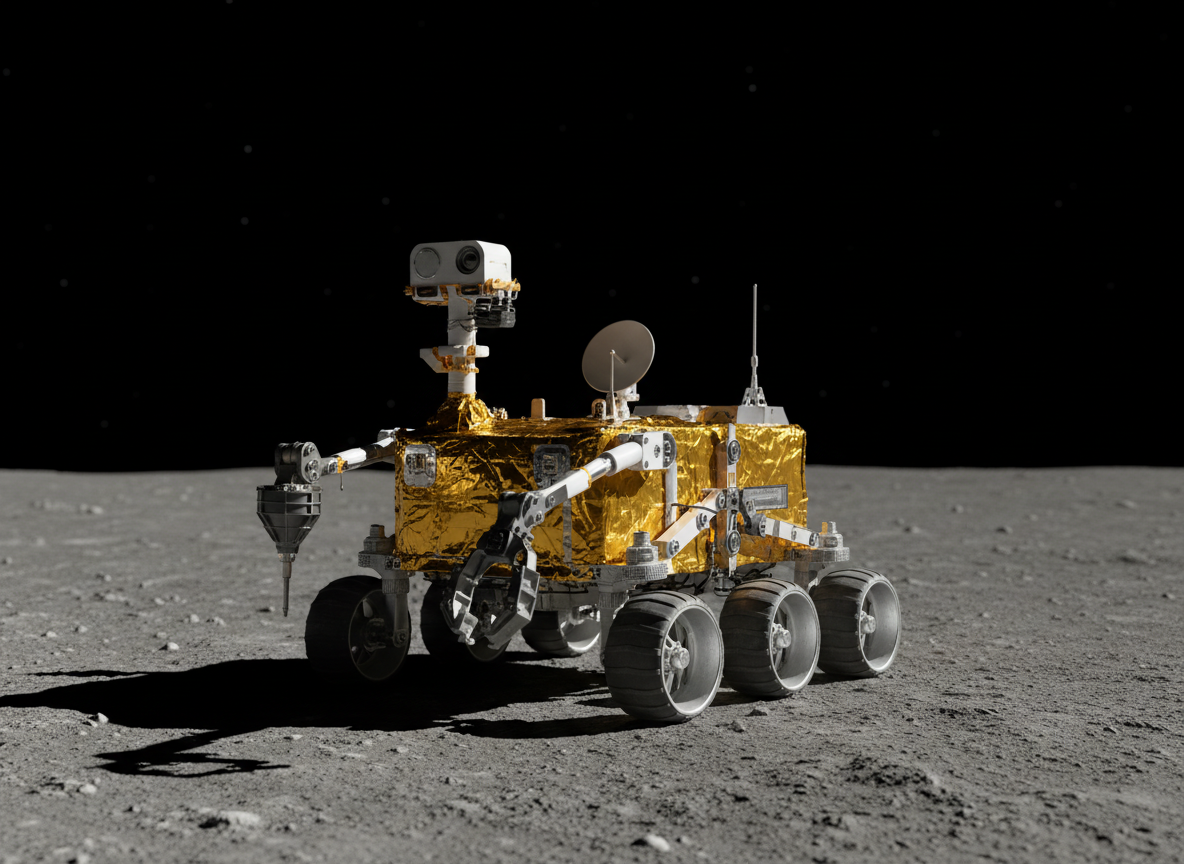
NEXUS-1 Scout will be OrbitExSpace's compact autonomous reconnaissance platform for lunar operations. Designed for rapid deployment and high-frequency traversal, the NEXUS-1 will be the primary forward intelligence agent for all lunar surface programs, operating ahead of heavier assets and in terrain that larger vehicles cannot safely access.
The NEXUS-1 platform will be manufactured in multi-unit batches. Up to six units will be deployed per mission, enabling persistent coverage of a 200 km² operational zone simultaneously. Each unit will function independently while contributing to a shared situational awareness mesh.
Department
Autonomous Reconnaissance & Mapping Division
Fleet Size
Up to 6 units per mission
Mission Duration
Continuous — rolling replacement cycle
Design Heritage
Yutu-2 / Pragyan mobility reference
Technical Specifications
Chassis
4-wheeled compact frame, carbon composite
Mass
~185 kg
Power Source
Foldable solar array, 140W peak
Operating Range
30 km/sol at maximum autonomy
Sensor Suite
LiDAR, stereo cameras, hyperspectral imager
Comms
S-band + UHF dual-mode relay
AI Architecture
Neural Autonomy v4, rapid terrain inference
Deployment Method
Rover-ejected or lander-deployed
Operational Duties
Terrain Scouting
NEXUS-1 Scout will precede the OEX Lune-Traverse I by up to 5 km, autonomously assessing traversability, hazard identification, and optimal path routing. Real-time maps will be transmitted back to the primary rover for route confirmation.
3D Terrain Mapping
Using a forward-facing LiDAR array, NEXUS-1 Scout will build high-resolution 3D surface maps at 2 cm resolution, exceeding the mapping fidelity of the Yutu-2 and Pragyan rover programs from which its compact chassis design draws partial engineering heritage.
Communication Relay Chain
Multiple NEXUS-1 units will be stationed at intervals to form a relay chain extending communications coverage to assets operating in permanently shadowed craters where orbital relay line-of-sight is unavailable.
Hazard Monitoring
The unit will continuously monitor for micrometeorite impact events, thermal gradient shifts, and surface instability. Alerts will be uplinked autonomously without requiring ground confirmation.
Autonomous Recharging
NEXUS-1 Scout will navigate to designated solar-exposure ridgelines to recharge its battery cells. Recharge routing will be planned and executed without ground intervention using onboard solar irradiance prediction algorithms.